


Torres del Paine: the granite cathedrals of Chile
A truly iconic image of Chilean Patagonia, the Torres del Paine National Park is the most famous destination in the country. Its three granite towers soar towards the sky, framed by turquoise lakes, imposing glaciers and visible wildlife: guanacos, rheas, skunks, hairy armadillos, foxes, and with a little luck, the puma.
When to explore Torres del Paine?
The austral summer (December-February) remains ideal: temperatures between 10°C and 20°C, long days, but heavy crowds. To avoid the crowds, favour the shoulder months (November or March), with the added bonus of the blazing colours of autumn in March. Be warned: the weather remains capricious, with violent winds and four possible seasons… in a single day.
Hikes and circuits
The park offers several trails that have become famous, such as the “W” trek (4-5 days) or the full “O” circuit (around 8 days).
For those who wish to enjoy the park without undertaking long treks, many easy trails allow for a day hike. The longest day hike is the Base Las Torres, which is around 20 km there and back, and gives a phenomenal view of the famous granite towers. The walks around Salto Grande, very accessible, allow you to observe the local wildlife in just 1 km of walking.
Finally, the trail leading to the Lago Grey, over around 4 to 5 km, leads to an impressive panorama over the Grey glacier and its floating icebergs.
Perito Moreno: the ice giant of Argentina
On the Argentine side, the Los Glaciares National Park is home to one of the most dazzling natural wonders of the South American continent: the Perito Moreno glacier. This colossus of ice covering 250 km², a rare advancing glacier, unfolds a front 5 km wide and 60 metres high. The roar of the blocks that break off and plunge into Lake Argentino offers an unforgettable sensory spectacle.
A living and accessible glacier
The Perito Moreno, once renowned for its stability and its steady advance, today shows signs of a more marked retreat than before, a phenomenon now closely monitored by glaciologists.
Despite this evolution, the glacier remains alive and spectacular: its impressive ice ruptures, which break off into Lake Argentino. These scenes can be observed in complete safety from purpose-built walkways, making this glacier one of the emblematic experiences of any trip to Patagonia.
When to visit the Perito Moreno?
The ideal period runs from November to March: mild temperatures (8°C to 15°C) and more frequent ice ruptures. Winter (June-August) is an alternative for photographers: fewer tourists, temperatures around -10°C, and exceptional light on the blue ice.
Ushuaia and the Beagle Channel: the end of the world
What is the best time to visit Ushuaia?
Summer (December-March) has the best conditions: temperatures from 5°C to 15°C and days of 17 hours of daylight. Winter (June-September) transforms the region into a ski resort at Cerro Castor, with temperatures down to -10°C. The weather remains capricious all year round – snow can catch you out even in the middle of summer.
Reaching Ushuaia means touching one of the most southerly towns on the planet. Nestled between the Andes and the Beagle Channel, this port city where the mountains plunge into the sea stands out as an essential stop to discover the essence of Patagonia.
Land excursions and sailings
A boat excursion on the Beagle Channel shows several colonies of sea lions and cormorants on the islets, as well as the legendary Les Éclaireurs lighthouse. A few kilometres away, the Tierra del Fuego National Park reveals sub-Antarctic forests and trails leading to Lapataia Bay, the final point of the Pan-American Highway that begins in Alaska. For travellers in search of adventure, the Australis cruises allow you to continue the exploration beyond the Beagle Channel, through the fjords of southern Patagonia as far as the legendary Cape Horn, the last headland before Antarctica.
El Chaltén and the Fitz Roy: the Argentine capital of hikers
Founded in 1985, El Chaltén quickly established itself as THE must-visit spot for hikers in Patagonia. At the gateway to the Los Glaciares National Park, this small mountain town gives privileged access to the Fitz Roy massif and its granite peaks that pierce the austral sky. It cultivates the charm of a mountain village: warm cafés, craft breweries and a relaxed atmosphere where hikers from all over the world share their adventures.
Legendary hikes: Fitz Roy and Cerro Torre
Mount Fitz Roy (3,405 m), recognisable by its jagged silhouette, remains reserved for experienced climbers. But hikers can approach its base via the Laguna de los Tres trail: a demanding day’s walk rewarded by a dizzying panorama of the Fitz Roy reflected in the turquoise waters of the glacial lake. Another classic: the Laguna Torre, dominated by the impressive spire of the Cerro Torre. This less difficult trail crosses varied landscapes to this lake where icebergs detached from the Grande glacier sometimes float. Allow 3-4 hours one way for the Laguna Torre, 8-10 hours there and back for the Laguna de los Tres.
When to hike at El Chaltén?
The months between December and March are the best: temperatures from 10°C to 20°C, less rainfall and long days for hiking. Beware of the powerful winds possible at any moment. The transitional months (November and April) are a little less busy, with the magnificent autumn colours in April. Winter (May-September) sees the town empty out, several establishments close and the trails often become impassable under the snow.
Península Valdés: the kingdom of whales and penguins


When is the right time to visit the Península Valdés?
The best time depends on your priorities: September to November for the whales, February-March for the orcas. The semi-arid climate shows 5°C to 12°C in winter, 15°C to 25°C in summer. Powerful winds blow all year round, particularly in summer.
Inscribed as a UNESCO World Heritage Site, the Península Valdés on the Argentine Atlantic coast is considered one of the best sites in the world for observing marine wildlife. This natural sanctuary is home to colonies of sea lions and elephant seals, but its true star remains the southern right whale which comes to breed there each year.
Marine wildlife sanctuary
These giants of the seas sometimes move within a few metres of the shore, notably from Puerto Pirámides. The peninsula is also famous for its orcas which practise a hunting technique unique in the world: they deliberately beach themselves on the shores to capture sea lions. Nearby, Punta Tombo is home to tens of thousands of Magellanic penguins, completing this exceptional wildlife picture for any stay in Patagonia.
Carretera Austral: Chilean Patagonia in its purest form
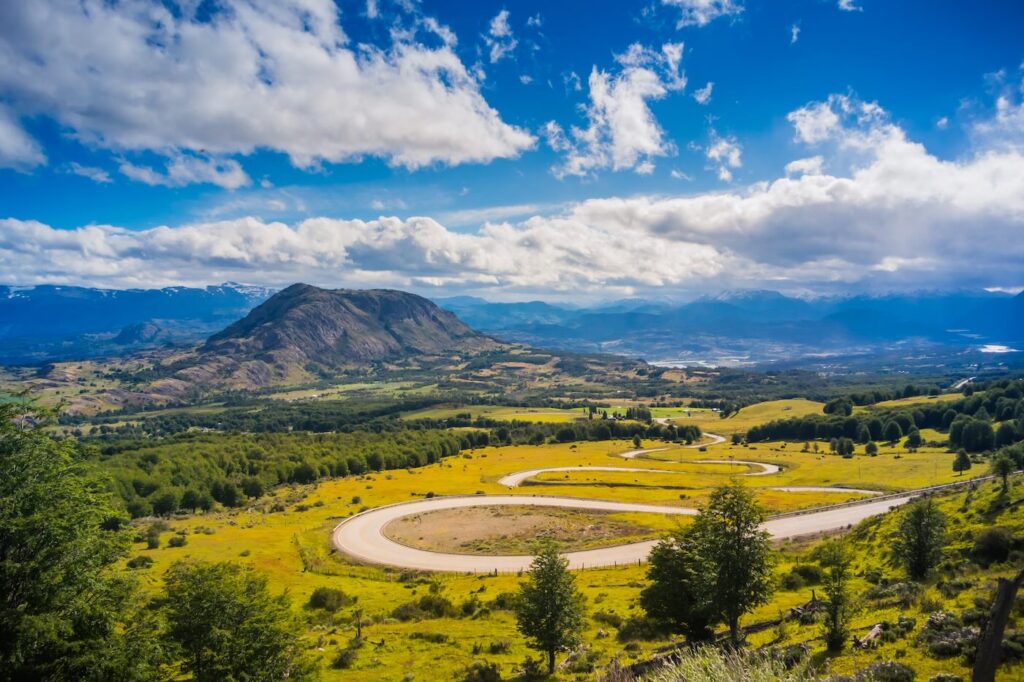
National Route 7 is far more than a simple road: it is an adventure in itself and one of the most beautiful roads in the world. Stretching over more than 1,200 kilometres from Puerto Montt to Villa O’Higgins, this mostly unpaved road crosses landscapes of astonishing diversity: humid temperate forests, fjords, glaciers, turquoise rivers and verdant valleys. To travel it by car, by bike or even on foot is to immerse yourself in an authentic Patagonia, far from the classic tourist trails.
The best time to travel the Carretera Austral
Summer (December-March) remains the ideal period: less rainfall, temperatures from 10°C to 20°C, and all sections accessible. Certain ferry crossings close in winter owing to the difficult conditions. Even in summer, be prepared for abrupt weather changes and frequent rain, especially in the northern part, one of the wettest areas in Chile.
The must-see sites of the Carretera Austral
Among the many treasures of this route: the Pumalín National Park, created by the philanthropist Douglas Tompkins, the hot springs of Puyuhuapi, the Capillas de Mármol (marble chapels) on Lake General Carrera, and the Exploradores glacier. Cerro Castillo, often nicknamed the “little brother” of Torres del Paine, offers magnificent and far less busy hikes. Further south, the Laguna San Rafael, accessible only by boat or plane, allows you to observe the impressive San Rafael glacier up close. Finally, the Chacabuco and Jeinimeni valleys, part of Patagonia Park, are among the rising tourist destinations.
The Seven Lakes Route: mirrors of water and Andean mountains


When to travel the Seven Lakes Route?
The ideal period runs from December to March: pleasant temperatures of 15°C to 25°C, a fully passable road and summer activities (hiking, kayaking, fishing). Autumn (April-May) offers magnificent shades of colour, ideal for a photographic road trip. In winter (June-September), certain sections may be snow-covered. Expect possible rainfall all year round, a characteristic of the mountain climate of the region.
The Seven Lakes Route (Ruta de los Siete Lagos) is one of the most prodigious scenic itineraries in Patagonia.
Linking Villa La Angostura to San Martín de los Andes over 110 kilometres, this route crosses a concentration of sublime landscapes, between centuries-old forests and Andean mountains, where each lake – Lácar, Espejo, Correntoso, Escondido, Villarino, Falkner and Machónico – reveals its own shades of blue and green.
Extension: Bariloche and the Nahuel Huapi Park
Nearby, San Carlos de Bariloche, nicknamed “the Argentine Switzerland”, is an ideal extension for exploring the Nahuel Huapi National Park, the first national park in Argentina. Cerro Catedral, a large ski resort in winter, allows you to do beautiful hikes in summer. The ascent of Cerro Campanario reveals one of the most beautiful panoramas of the region over the surrounding lakes and mountains.
Punta Arenas: at the gateway to the Strait of Magellan
Located on the shores of the Strait of Magellan, Punta Arenas was once one of the richest cities in South America thanks to its strategic role as a resupply port before the opening of the Panama Canal. Today, its colourful Victorian architecture bears witness to this prosperous era and makes it an important stop for understanding the history of Patagonia.

When to visit Punta Arenas?
The austral summer (December-March) remains ideal, with temperatures from 7°C to 15°C. Be warned: Punta Arenas is one of the windiest cities in the world, with strong and constant winds all year round. The oceanic subpolar climate brings regular rainfall even in summer. The penguin colony of Magdalena Island is visible from September to April, with an optimal period from December to February.
From the Strait of Magellan to Pali Aike Park
The city serves as a base for exploring the Strait of Magellan and its islands rich in history and biodiversity. The must-see excursion remains Magdalena Island, which is home to an enormous colony of more than 120,000 Magellanic penguins. Fort Bulnes, a reconstruction of a 19th-century military post, plunges you into the history of the first colonists. The Brunswick Peninsula, with its San Isidro lighthouse, allows you to observe dolphins and whales. A few hours’ drive away, the Pali Aike National Park reveals a lunar landscape shaped by ancient volcanoes, where some of the oldest traces of human presence in the Americas were discovered.
Andean lakes: the lake crossing between two worlds
What is the best time to do the lake crossing?
The best period runs from September to April (spring and summer), with long, bright days ideal for enjoying the landscapes. Winter (May-August) has its own particular charm, but the short days make it advisable to spend the night at Peulla to fully savour this scenic crossing.
The Cruce Andino is far more than a simple journey: it is one of the most spectacular crossings between Argentine Patagonia and the Chilean Lake District. This natural corridor links Bariloche to Puerto Varas by revealing some of the most verdant landscapes of the Andes: sailing on emerald lakes, mountain roads between snow-capped volcanoes and dense forests.
A crossing in several stages between lakes and volcanoes
The adventure begins at Bariloche, in the heart of the Nahuel Huapi National Park. From the port of Puerto Pañuelo, a catamaran skirts the Llao Llao peninsula as far as Puerto Blest, amid lush vegetation. After short transfers by bus and boat via Puerto Alegre and Puerto Frías, you cross the border to reach Peulla, a Chilean village nestled in the Vicente Pérez Rosales Park. It is there that the spectacle reaches its peak: before you rise the Osorno volcano dominating Lake Llanquihue, the Puntiagudo and the Tronador straddling the two countries.
The final crossing over the crystal-clear waters of Lake Todos los Santos to Petrohué sails through a setting of greenery, eternal snows and an azure sky, before reaching Puerto Varas. This 1- or 2-day crossing concentrates all the magic of the Patagonian Lake District.
Chiloé Island: marine legends of the Pacific
Located at the gateway to Chilean Patagonia, the island of Chiloé is a world apart, steeped in myths and traditions. Isolated from the mainland for centuries, it marks the transition between the temperate forests of southern Chile and the untamed landscapes of the Far South, with a unique culture, visible in its colourful architecture, its maritime gastronomy and its folklore peopled with legends.
UNESCO churches and Pacific landscapes
The wooden churches of Chiloé, inscribed as a UNESCO World Heritage Site, embody this particular cultural identity. Built entirely from local wood (including the nails) by naval carpenters in the 18th and 19th centuries, they blend European influences and indigenous techniques in an architecture without equal.
Beyond its cultural heritage, Chiloé has fascinating natural landscapes: humid temperate forests, wild beaches battered by the Pacific, and wetlands home to a rich birdlife, including colonies of Humboldt and Magellanic penguins.
When to visit Chiloé?
The mildest period of the year, between December and March, has less rainfall and temperatures ranging from 10°C to 20°C. Be warned: Chiloé is famous for its rainy climate – the locals say there are “thirteen months of rain a year”. In winter, temperatures rarely drop below 5°C, but the constant humidity and frequent rains make exploration less comfortable.
The must-sees of Patagonia: your questions for planning your itinerary
Where to start in Patagonia when you don’t know the region?
Torres del Paine on the Chilean side and El Calafate with the Perito Moreno on the Argentine side form the most logical starting pair for a first trip. These two sites are well served, close to each other and cover the essentials of what Patagonia has to offer. Allow a minimum of ten days to do them properly without feeling rushed.
Can you combine Chilean and Argentine Patagonia in a single trip?
Yes, and it is even what we recommend. Torres del Paine and El Calafate are a few hours' drive from each other, with an easily crossable border. A well-constructed itinerary can incorporate El Chaltén, Ushuaia and the Península Valdés on the Argentine side, and the Carretera Austral or Chiloé on the Chilean side, depending on the time available.
How much time should you plan for a trip to Patagonia?
It all depends on the sites you have in mind and the pace you want. Torres del Paine alone deserves a minimum of four days on site, not counting the transfers. El Calafate and El Chaltén add as many again. Ushuaia, the Península Valdés, the Carretera Austral and Chiloé are each destinations in their own right that must be earned. Wanting to see everything in three weeks means skimming over it. Our team helps to weigh things up according to your priorities, your pace and the chosen period to build an itinerary that makes sense rather than a programme to tick off.
Which site is best suited to a traveller who doesn’t like hiking?
The Perito Moreno is accessible from purpose-built walkways, without physical effort. The Península Valdés can be visited by car and by boat. Punta Arenas and Chiloé are discovered on foot in town or on a short excursion. The Seven Lakes Route is travelled by car with scenic stops. These four destinations offer a spectacular Patagonia without requiring any particular level of fitness.

Passionate about Chile long before she ever set foot on the South American continent, Marilys has turned this fascination into her profession. Specialising in digital content at Korke, she draws on her own discoveries to create practical guides for travellers.
Her versatility and her eye for detail, nurtured by her explorations across Chile and Argentina, come through in every recommendation. Her traveller's instinct and her attention to what these southern lands reveal beyond appearances invite you to discover them with insight and sensitivity.


